My Politics Are The Moderate Position
"Abolish ICE is the moderate position."
If you are reading this, you have probably seen this phrase online. I trust that I do not need to explain the actions taken by agents representing Immigrations and Customs Enforcement in Minnesota and other places over the last weeks and months, and I trust that I do not need to argue that they are reprehensible. I am here interested in what it means to call something "the moderate position," and what someone who says this is intending to convey.
Without getting all "Webster's Dictionary defines" ass, the meaning of "moderate" is paradoxically hard to define because it cannot be defined without reference to some "extremes." And, of course, the relationship between what is moderate and what is extreme is highly dependent on cultural context. You can pick your example; it is obvious that certain "moderate" positions from 20, 60, 100 years ago would be considered extreme today, and vice versa.
Is it good to be moderate? It sounds good, doesn't it? Synonyms for moderate could be like...reasonable. Level-headed. You sound like you know what you're doing, and not taking unnecessary EXTREME positions. But if moderate is only defined in relation to extremes, what does that mean when circumstances change?
Before I get into American politics with the next paragraph, I should say that I myself struggle a lot with how to define my own politics and my own desire to be considered moderate. On Bluesky, I am center to center-right. I prefer market economies to centrally planned ones, am negatively polarized in favor of Will Stancil (if you don't know what this means, may God bless you and keep you that way), and do not consider the United States of America axiomatically evil. On Wall Street, I am far-left. I voted enthusiastically for Zohran Mamdani as mayor of New York City, I think supporting Donald Trump and his policies for any reason is at best moronic cowardice, I think every billionaire is a policy failure. Can you tell that I have framed all of these things to sound moderate?
A popular meme on both the American right and left (I am using the term "left" under protest here; I expect to have more to say on that in future writings) involves the protagonist of the meme standing on a line between the Democratic and Republican parties, and then becoming suddenly baffled as one of them sprints in the more extreme direction. This is how Elon Musk justified his support for Republicans, and it could be seen as applying to how some Never-Trump Republicans became functionally Democrats.
I believe that most people want to be considered moderate without changing their own positions, and part of the reason that I believe this is that this is what I want also.
"I must confess that over the last few years I have been greatly disappointed with the white moderate."
-Martin Luther King, Jr., Letter From Birmingham Jail, 1963
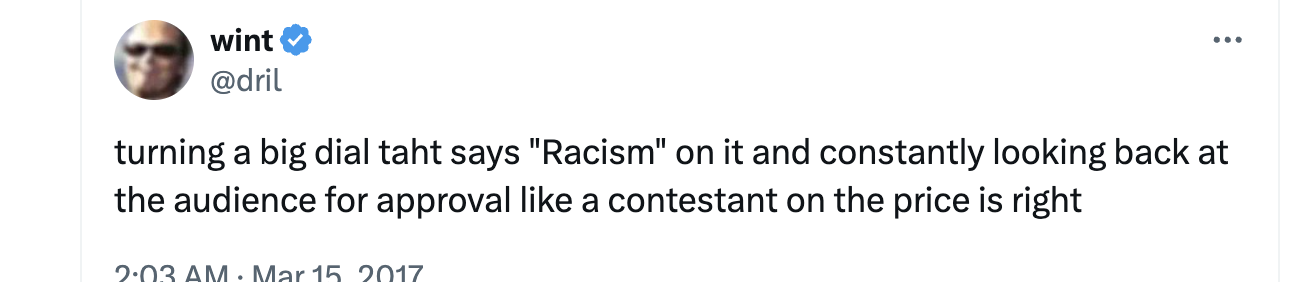
"turning a big dial taht says "Racism" on it and constantly looking back at the audience for approval like a contestant on the price is right"
-Dril, Twitter, March 2017
In his letter from Birmingham Jail, Martin Luther King Jr. describes the white moderate as "prefer[ring] a negative peace which is the absence of tension to a positive peace which is the presence of justice," and "constantly say[ing] "I agree with you in the goal that you seek, but I cannot agree with your methods of direct action."
It is not hard to find examples of this behavior today, in response to Colin Kaepernick's kneeling, pro-Palestine protests, etc. "You have a point, but do you have to make it so Loudly and indecorously?" It is related to what I have seen called "wrong rock" theory, where someone asks for a rock, and when brought a rock, says that it is the wrong rock without further explanation - the implication is that this person is not acting in good faith, that every rock will end up being wrong. This continues to be seen in right-wing (and sometimes centrist) responses to protests against racial injustice, and also sometimes in left-wing criticisms of Democratic politicians.
At the core of the opposition to King's "white moderate" or to "wrong rock" people is the idea that they are arguing in bad faith; that they are saying that, because they are "moderate," that they will accept a "moderate" solution, but then defining that word such that they never have to agree with the people that they have already determined they will not support.
While she was writing Harry Potter, J.K. Rowling surely thought of herself as progressive. I think that Dave Chappelle thought of himself and still does as on the left and anti-reactionary. These two are perhaps more accurately categorized as "Once You Get Angry About Trans People, It Takes Over Your Entire Life And Makes You Reactionary," which is a subject for another time. But they also exemplify a phenomenon I struggle with, the reaction that people who consider themselves to be on the left, to be on the side of righteousness and justice, have to being critiqued from their own side - a sort of indignation, like, what do you mean I'm not good enough? Fine, if you're going to bully me I'm not going to listen to you - there is a comic about the sort of Look-What-You-Made-Me-Do, I don't want to be a Nazi, but you call me one response that is possible under some circumstances.
I struggle with this because - how does one draw that line? It seems fairly clear to me that, say, J.K. Rowling, or Nate Silver, or Gavin Newsom, are not actually progressive or on the left, and that the contention that they are the "moderate" "reasonable" ones has led them to accept too much bad faith from the right. But it is equally clear to me that people on the left who call e.g. Alexandria Ocasio-Cortez a Zionist are ridiculous at best, and deeply anti-Semitic at worst. But maybe I too am too enamored of my own moderation; I don't want to abolish capitalism, after all.
"Everything in moderation, including moderation"
"Abolish ICE is the moderate position" is a prescriptive statement, not a descriptive one. It is aspirational, aimed at a definition of moderate that implies that "moderates" do not actually have any principles and instead will simply adopt the positions that they perceive to be in some imagined middle of the discourse. It is saying to those people, "when you eventually adopt our position because enough people have done so, you will wish you had done so sooner."
Everybody wants to be "moderate" - rational, level-headed, considering all situations and coming out with the perfect synthesis. Nobody wants to be "moderate" - unprincipled, weathervane, wishy-washy, seeking to position themselves exactly in the middle of two extremes without considering what those extremes actually are. The prescriptive statement "X is the moderate position" is people claiming to be the first thing saying that people who are the second thing are going to agree with them later so they should agree with them now.
I think it is natural to want your own positions to be "moderate." The best way to do that, in my opinion, is to have convictions and stick to them. If you live your life in a way that makes other people want to be more like you, you will become more moderate.
Also, Abolish ICE. After all, it is the moderate position.